Goat Hay for Winter on a Budget: Best Types, Quality Secrets, Storage & Waste Tips That Actually Save Money
Cold weather is coming, and now is the time to buy hay for the winter. I don’t know about you, but putting up hay the winter always feels like a big spend upfront. It’s tempting to check out that deal you saw on marketplace for a cheaper supply, but it’s cheaper for a reason. Bad hay means more grain, more mineral, more refusals on the ground, and sometimes a vet call when something goes sideways. So, is saving a few dollars in the fall worth it by the end of the winter? No. The good news is you do not need a fancy barn or premium prices to get this right. You need the right type for your goats, a sharp eye for quality, simple storage that keeps it dry, and a feeder setup that stops them from turning half the bale into bedding. This is the practical version for people who want their herd fed well without the feed bill eating the rest of the budget.
Top Three Hay Picks That Actually Work for Goats
Orchardgrass is the everyday workhorse for a lot of herds. Early-cut orchardgrass typically runs 10–14% crude protein and around 55–62% TDN (Total Digestible Nutrients), with a calcium-to-phosphorus balance that is safer for bucks and wethers than pure legume hay. Goats like it, it holds up reasonably well in storage when cured right, and it meets maintenance needs for dry does and adult animals without pushing them into fat. As a comparison, the average bag of goat feed runs about 16% protein. Research on cool-season grasses shows orchardgrass holds its digestibility better than some other grasses when managed for hay, and it pairs cleanly with a good mineral program. For most small herds on a budget, this is the base layer that keeps the rumen working without extra bags of feed.
Timothy sits in a similar lane and is often easier to find clean in horse country. Protein is usually a little lower (often 8–12% depending on cutting and maturity) and TDN lands in the mid-50s. It is soft enough that goats will eat the leaves and still get enough fiber from the stems. The advantage is consistency and lower risk of the high-calcium problems that show up when bucks get too much alfalfa. When you are feeding mixed ages and sexes through winter, a solid timothy or timothy-orchard mix keeps the program simple. Extension tables consistently show these grasses delivering enough energy and protein for maintenance once the goats are past peak lactation or growth.
Alfalfa or an alfalfa-grass mix is the third pick, and it earns its place when you have does in late pregnancy, early lactation, or kids that need to grow. Alfalfa commonly tests 15–20% or higher crude protein with TDN in the upper 50s to mid-60s and significantly more calcium than grass hays. That calcium is useful for milk production and bone, but it is exactly why pure alfalfa should be limited or avoided as the only forage for bucks and wethers. A 50/50 or 60/40 alfalfa-grass mix gives you the protein boost for productive animals without the full calcium load. Studies on forage blends show that modest alfalfa inclusion improves overall digestibility and intake compared with pure late-cut grass, which is the difference between goats holding condition on hay alone versus needing daily grain.
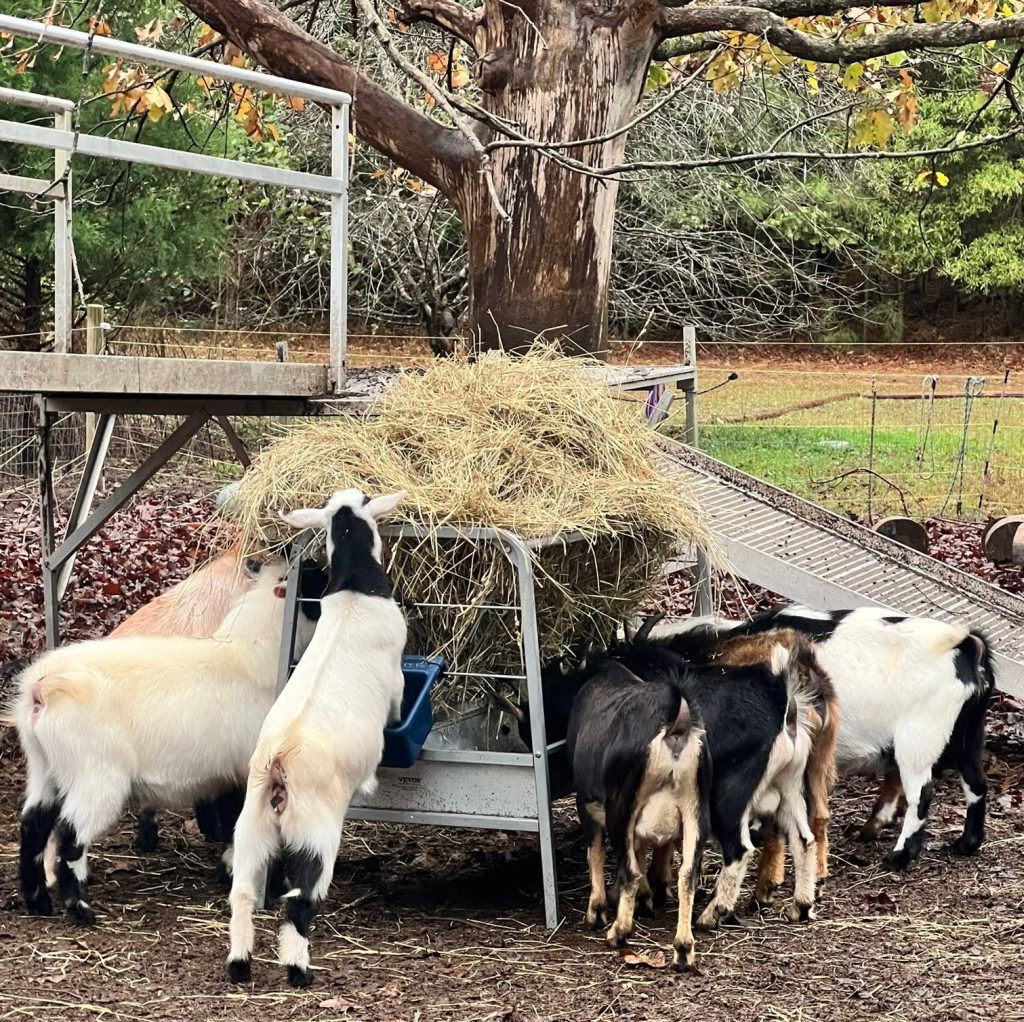
Let’s put this together in nutrition and budget terms. The idea of feeding our goats beautiful alfalfa hay is not practical from a budget or nutritional standpoint, and not needed. Honestly, because of the cost of alfalfa hay it is not an option for most goat owners. The best option to get the most nutritional bang for your buck is feeding an orchardgrass, or orchard timothy mix. For goats that need supplemental support through the winter at a maintenance level when browse and forage are low in their fields, this will do the job. If you have dairy goats or those that need the extra protein and calcium, adding a small amount of alfalfa your winner. In some cases, for storage and budget, buying alfalfa pellets is a better option than a second type of hay to store. This is what I do, quality orchard grass hay and supplement with alfalfa pellets for my does when needed.
The pattern across all three is the same: quality of the cutting matters more than the species name on the tag. Early to mid-bloom or vegetative grass will outfeed a stemmy, over-mature alfalfa every time. Ask your supplier if they have done a nutrient analysis on their hay; the numbers on the report beat any label that just says “goat hay.”
How to Pick Quality Hay (and Why Horse Quality Beats the Cheap Goat Bale)
The cheapest bale is rarely the cheapest feed. “Goat hay” is often the stemmier, later-cut, or lightly weathered product that did not make the horse market. Goats will pick through it and leave the coarsest stems, so you pay for weight you never get into the animal. Horse-quality hay is simply cleaner, leafier, and cured under better conditions. Horses are sensitive to dust and mold, so the market that serves them ends up with hay that is also safer and more palatable for goats. I have 7 horses on my property from age 2 years to 30+ years who range from 250lbs to 2000lbs, my goats and horses all get the same hay. Trust me, quality matters.
When you look at a bale, start with the smell. Fresh hay smells sweet or lightly grassy. Musty, sour, or fermented odors mean mold (even if you can’t see it) or heating already happened. Color should be green to light gold through the middle of the bale, not brown or black. Sun-bleached exteriors are common and fine if the inside is still green. Heavy stem content and seed heads tell you the grass was mature when cut; protein and digestibility drop as the plant lignifies. Leaves should stay on the stems when you shake a flake. Leaves carry most of the protein and energy.
Moisture is the quiet killer. Hay baled above about 15–18% moisture is at real risk of mold, heating, and nutrient loss. Small squares can sometimes handle the upper end of that range; dense round bales need to be drier because they trap heat. Dust is the visible sign of mold spores or over-dried leaf shatter. Yes, dust can simply be because it was the bottom of the hay stack or from storage, so it’s important to look at more than just dust. Goats tolerate a little more dust than horses, but heavy dust still drops intake and can irritate airways. Goats who are closed in a barn in the coldest part of winter with dusty hay are more likely to have respiratory issues and pneumonia episodes. Pull several flakes from different bales and look inside. If the seller will not let you open a bale, walk away. The few dollars saved are not worth the refusals or the risk of respiratory or digestive trouble later. This is also why building a relationship and buying from the same hay supplier is important, not just whoever has hay available on your local marketplace page.
Storing Hay on a Budget When You Do Not Have a Big Barn
You do not need a hay loft, a large hay barn, or even a tractor. You need the hay off the ground, out of the rain, and with enough air movement that it does not sweat. Pallets or a gravel pad keep the bottom bales dry, pallets to elevate it are my go to option. A tarp works if it is loose enough for air to move and weighted so it does not flap and tear. Tight plastic that seals in moisture creates the exact conditions for mold. Stack squares with space between rows or alternate the direction so air can move. Rounds are harder. They need a well-drained spot, preferably under a lean-to or with the ends covered and the sides able to shed water. Expect more spoilage on the outside of uncovered rounds; plan to buy 10–15% extra if they sit outside all winter.
Squares usually win for small herds on a budget. They are easier to handle by hand, stack tightly in a shed or under a carport, and let you feed exact amounts. Rounds are cheaper per pound when you can buy by the ton, but the waste and the handling equipment often erase the savings unless you have a feeder that keeps goats off the top of the bale. Whatever you store, use the oldest first and check for heating or mold every couple of weeks. A single hot bale in the middle of the stack can ruin a lot of feed and create a fire risk.
I do not have a tractor, or a large barn. Yet, I feed round bales. My rounds are stored in areas where I can literally pull my truck and trailer up and push it off the back onto the ground then roll it up onto a pallet. Couple tarps and they are stored. I can fit one round in the bed of my truck and one on my small utility trailer. Yes, I have picked up a round with that utility trailer pulled by my minivan. Can’t push the round off, or have a strong teen to help? A tow strap secured around a tree and your bale, or a wench, are excellent alternatives. Another tip is if you can find a hay supplier who will let you pick up hay as needed through the winter. My hay supplier knows how many bales I need per month, and I simply go the couple miles to his farm to pick up hay every week, it keeps my hay stored through the winter without me having to have a hay barn. Limiting how long I have to store each bale. Canvas or metal carports are also a budget friendly storage option to keep your hay covered and dry.
Why Better Hay Saves Money After the Purchase
The sticker price is only the start. High-quality hay with good leaf content and reasonable protein lets goats meet more of their needs from forage alone. Dry does and open animals can often hold condition on decent grass hay plus a goat mineral. Does in late pregnancy or early lactation still need some extra energy, but the amount of grain drops when the hay is testing in the mid-50s TDN or better instead of the low 40s. Or even supplementing with a little alfalfa hay or pellets. When you calculate out the cost of hay per pound, and the cost of a bag of feed per pound, that number matters. That reduction in bagged feed and added supplements is real money by the end of winter.
Better hay also wastes less. If you have followed me for even a little bit, or owned goats for a season or two, you have learned that “goats will eat anything” is a lie. Goats refuse coarse, stemmy material. When half the bale ends up as on the ground as bedding, your effective cost per pound of nutrient doubles. Clean, leafy hay has higher intake and lower refusal, so the same number of bales lasts longer. Rumen function stays steadier on consistent, digestible forage, which shows up as fewer digestive upsets and better parasite resilience. The mineral program still matters—hay never replaces a good loose goat mineral—but you are not trying to correct a poor forage base with expensive supplements every day. Spend a little more per bale on something leafy and clean, then track how much less grain and how much less waste you see. Most people find the higher-priced hay is cheaper by March.
Five Practical Ways to Cut Hay Waste
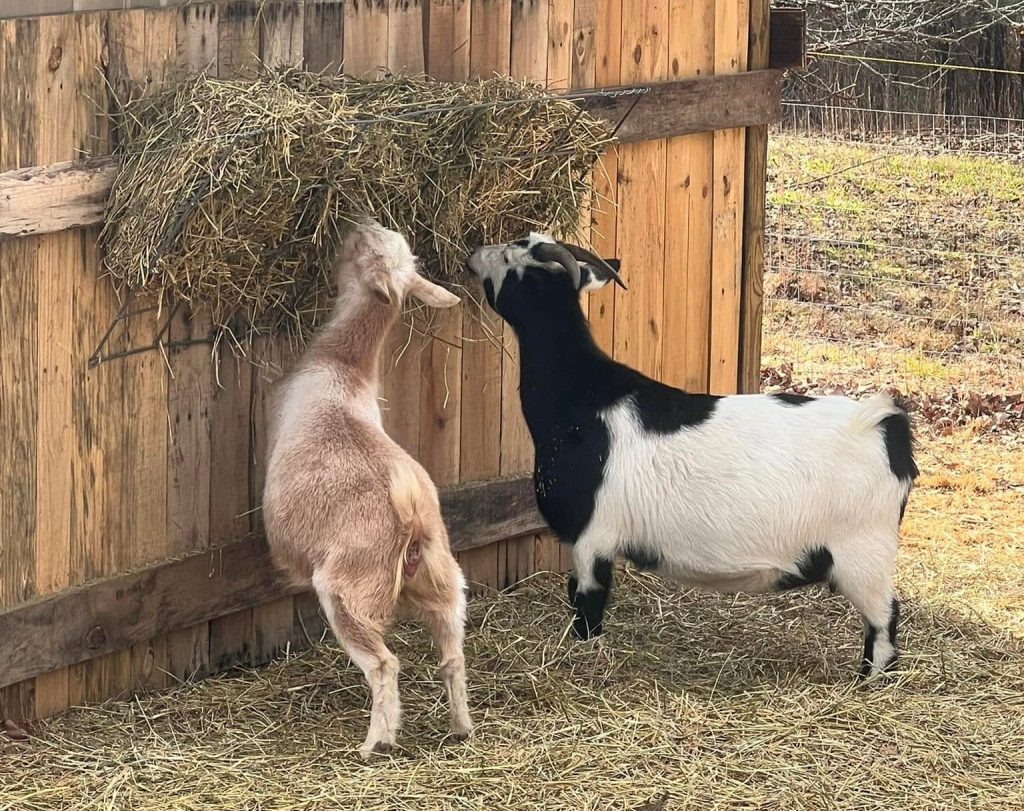
Goats are efficient at turning hay into bedding, it is a talent they have no matter how awesome of a hay feeder you have built. That does not mean hay feeder type and construction is not important. How you feed the hay definitely impacts waste since they will not even good quality hay once it touches the ground. An elevated rack or keyhole-style feeder that keeps hay off the ground and limits how much they can pull out at once drops waste dramatically. Designs with a solid tray or catch pan under the slats let goats clean up what they drop before it gets soiled, or gives you a chance to throw it back in the feeder without them knowing. Research on small ruminants shows feeder design can move waste from 30–50% down into the teens or lower when the animals cannot stand in the feeder.
Hay nets and slow-feed bags force them to work for smaller bites. They work on both squares and the outer layers of rounds, and they reduce the “pull and drop” habit. Hang them high enough that goats cannot get tangled but low enough that kids can reach. Check for wear; sharp horns and hooves will eventually chew holes. If you choose to use hay nets I highly recommend the slow feed ones or ones designed for miniature horses with smaller openings, reducing the risk of goats getting tangled in them. I definately would avoid if you keep horned goats, I have yet to see a hay net a horned goat will not get their horns tangled.
Feed measured amounts rather than dumping a whole bale and walking away. Most adult goats eat roughly 2–4% of body weight in dry matter per day depending on production stage and hay quality. Putting out what they will clean up in a few hours, twice a day, cuts the time hay sits where they can sort and soil it. Leftovers that stay clean can be offered again; anything trampled or wet goes to bedding.
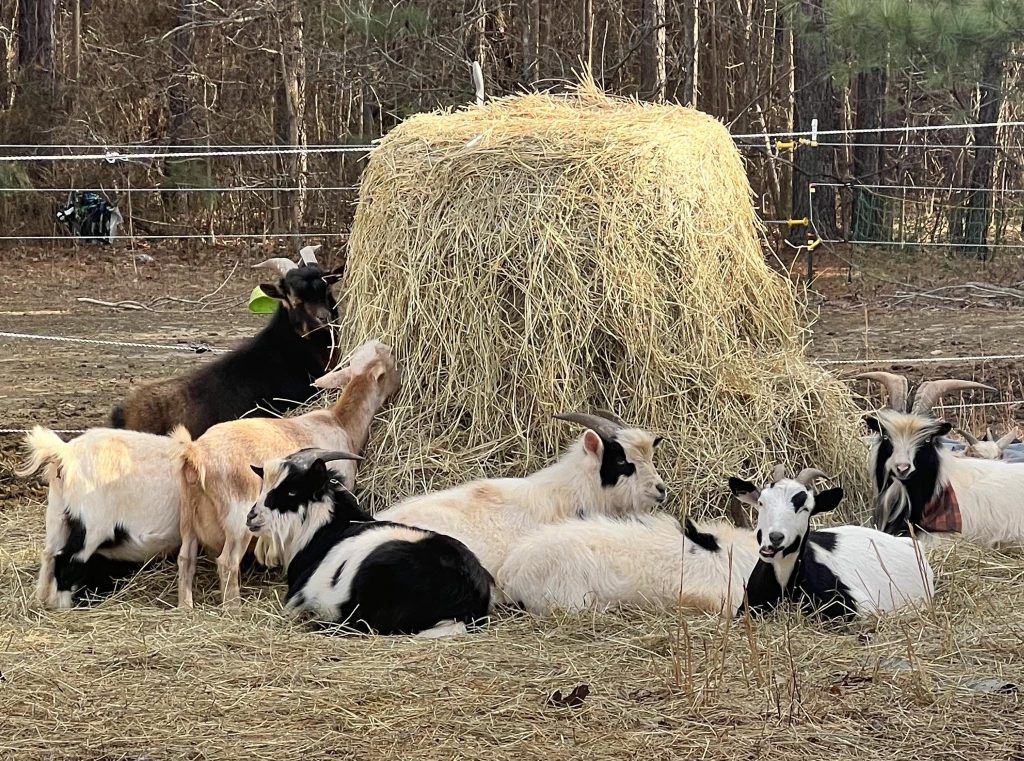
I have a small, wheeled cart & trash bin which get filled and dumped into their feeders morning and evening. I simply pull hay off my round bale stored near the pen, fill the containers, wheel them over and dump them in. I honestly don’t find it any more work than feeding square bales, and it is less per pound to feed round bales.
Multiple smaller feeders reduce competition. Dominant animals cannot guard one big pile and force the others to eat what is left on the ground. Spread the feeders so every goat has access without fighting, or utilize feeders that can be accessed from multiple sides. This matters more in mixed groups or when you have kids.
Finally, clean the area regularly and do not let refusals pile up. Wet, soiled hay is refused the next day and becomes a fly and parasite issue. Use clean waste as bedding if it is dry, and keep the feeding zone scraped or bedded so the next round of hay stays palatable. These five habits—better feeder, nets, measured feeding, multiple stations, and clean-up—turn the same pile of hay into more actual meals.
Thanks for hanging with me for another week. It’s my mission to provide homesteaders and goat owners with quality and researched information to help them reach their homesteading goals on a budget. I will always include my references at the bottom of my blogs for readers to continue their own research.
Carrie Lynn – The Shoestring Farm Girl.
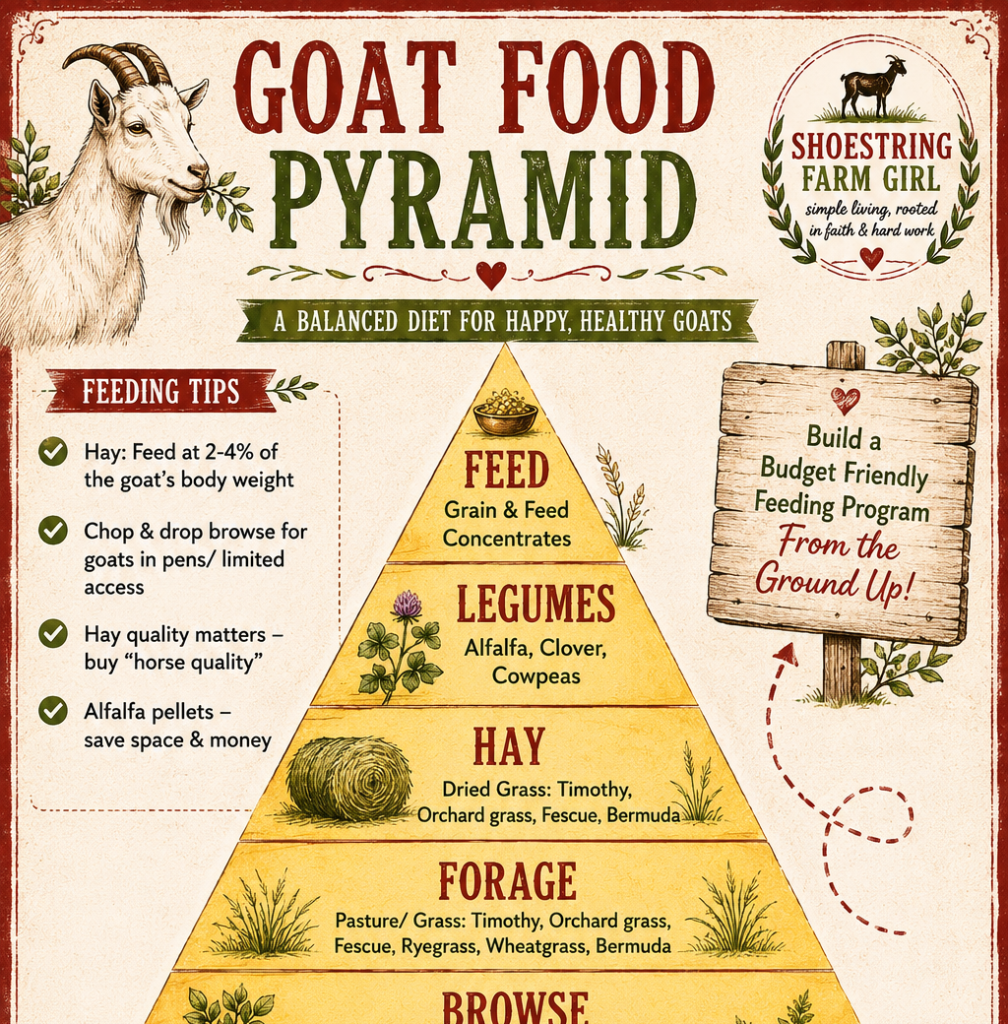
Don’t forget to sing up for our monthly newsletter and get the Goat Food Pyramid PDF for FREE! Get tips, helpful information for running your homestead directly to your inbox monthly. Keep up today on my newest book releases, special discounts and promo codes for SFG products.
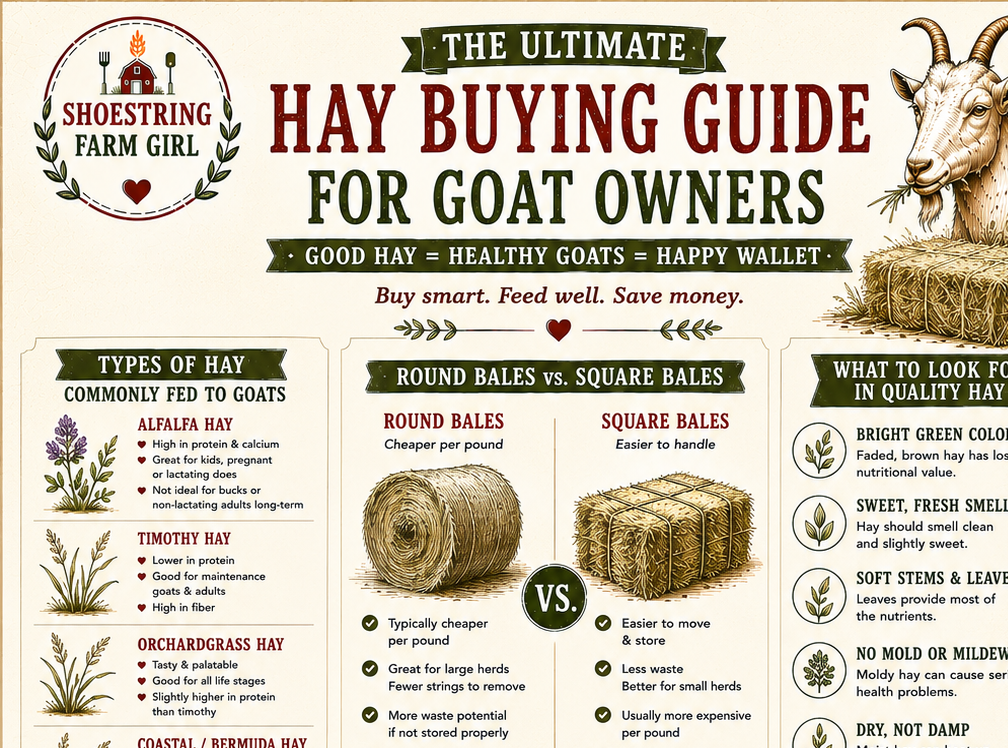
Check out my Budget Feed & Nutrition quick reference bundle that includes my hay buying reference guide.
References
Cornell Cooperative Extension. (n.d.). Vitamins and minerals for goats. https://cals.cornell.edu/nys-4-h-animal-science-programs/livestock/goats/goat-fact-sheets/vitamins-and-minerals-for-goats
Goat Journal. (2022). What is the best hay for goats? https://goatjournal.iamcountryside.com/feed-housing/what-is-the-best-hay-for-goats/
Langston University. (n.d.). Goat nutrition and feed composition resources. http://www.luresext.edu/
National Research Council. (2007). Nutrient requirements of small ruminants: Sheep, goats, cervids, and New World camelids. National Academies Press.
Ohio State University Extension. (2023). Manage feed costs by evaluating hay waste. https://u.osu.edu/sheep/2023/12/12/manage-feed-costs-by-evaluating-hay-waste/
Pennsylvania State University Extension. (n.d.). How to balance a ration for mature does. https://extension.psu.edu/
University of Minnesota Extension. (n.d.). Selecting and storing horse hay; Mold and mycotoxins in horse hay. https://extension.umn.edu/
University of Georgia Extension. (n.d.). Moldy hay risks for livestock. https://site.extension.uga.edu/
*Information contained in this blog is for educational purposes only. Please consult a licensed veterinarian with questions regarding the care of your animals.
-
Goat Hay for Winter on a Budget: Best Types, Quality Secrets, Storage & Waste Tips That Actually Save Money
Cold weather is coming, and now is the time to buy hay for the winter.…
-
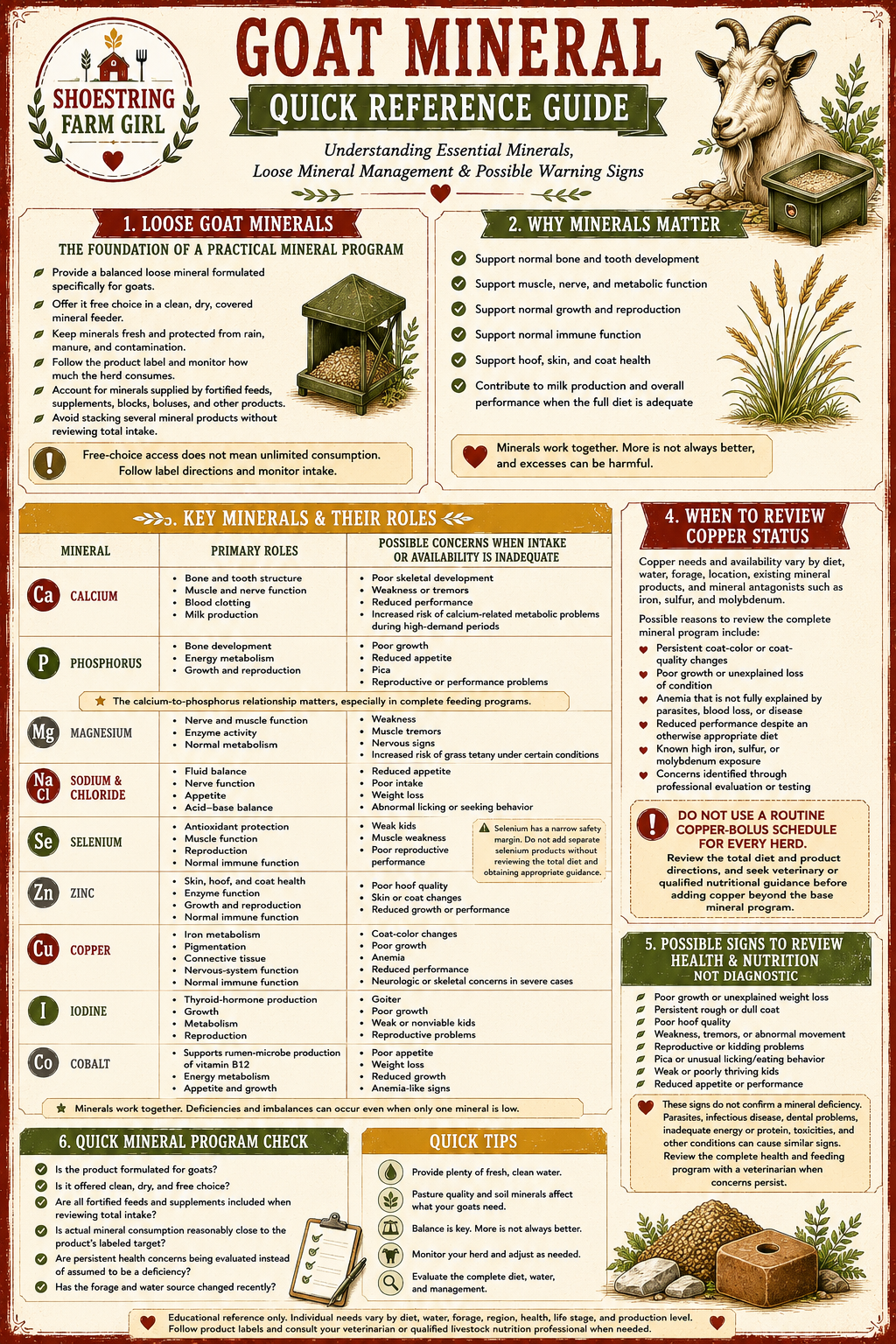
10 Minerals Your Goats Might Be Short On
10 Minerals Your Goats Are Short On and How to Supplement Without Breaking the Budget!…
-
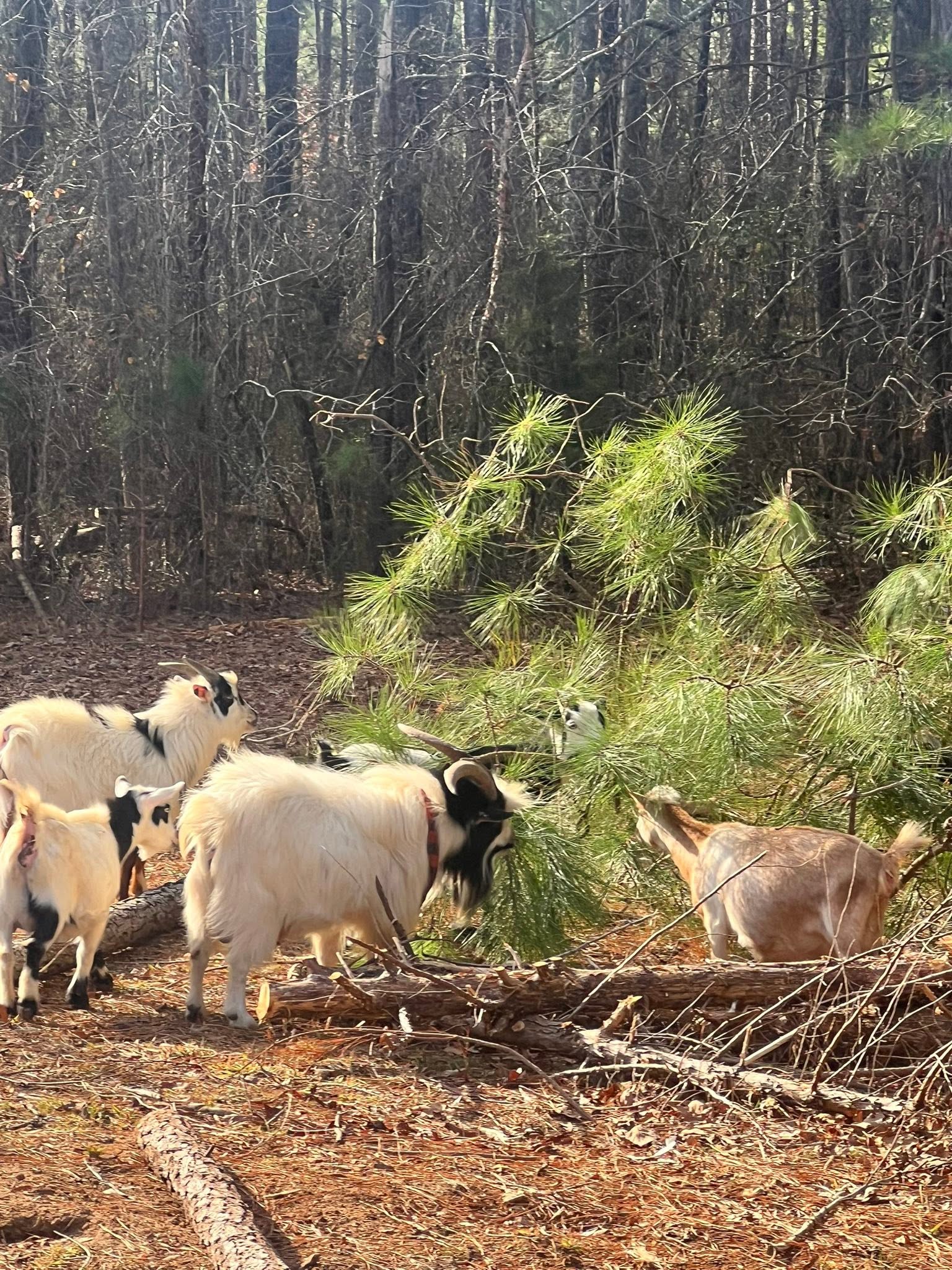
Natural Goat Dewormers: 5 That Hold Up on a Fecal, and 5 That Don’t!
Most “natural” goat dewormers die in the rumen. Here is what fecal trails and science…
