10 Minerals Your Goats Might Be Short On
10 Minerals Your Goats Are Short On and How to Supplement Without Breaking the Budget!
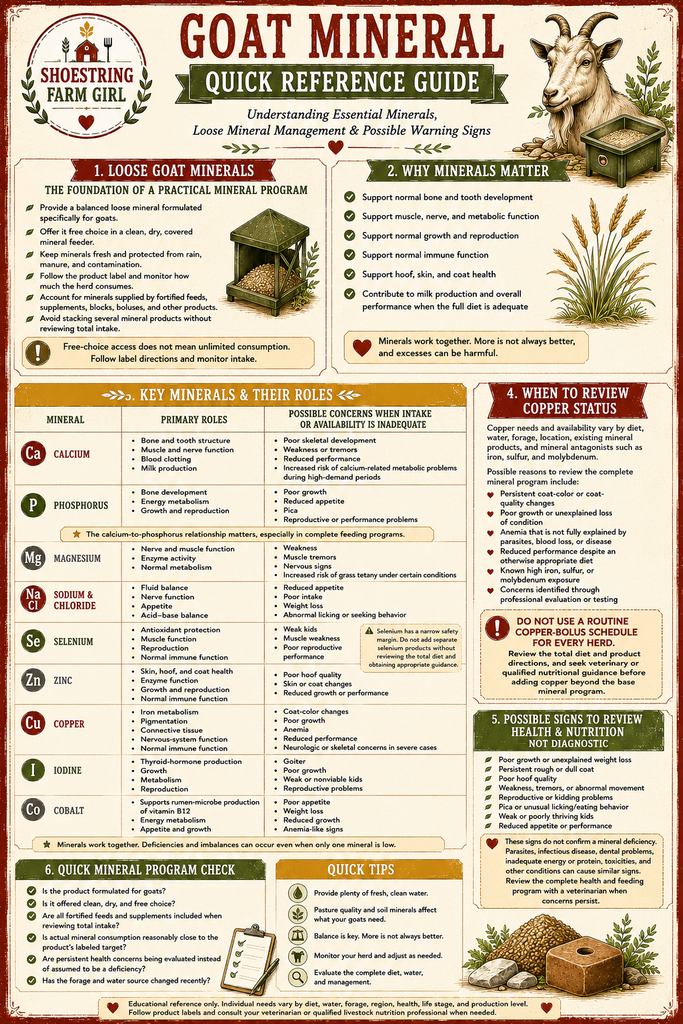
A goat mineral program does not need twenty little dishes individually labeled with each mineral. While goat mineral bars seem like a popular solution online, they don’t meet the daily needs of the average goat owner. Plus, who has time to fill and maintain 20 different little mineral cups? Where are you storing all those individual bags of minerals? What about if you have multiple goat pens, pasture rotation, different life stages, and production needs? It needs one dry feeder, a mix labeled for goats, and a clear idea of the two or three holes a bag cannot fill on your farm. The rest of the internet will sell you a bolus for every letter on the periodic table and with cute matching labels. Most of those holes are already in a decent loose mineral, if the goats will eat it.
Why the domestic goats run short
A goat is a browser being fed like a grazer, goats are not sheep and tiny cows. Browse is all the plants and stuff grazers don’t eat; weeds, bushes, leaves and bark off trees, that annoying poison ivy you have been trying to eradicate, and your favorite rose bush. Or in case both of my favorite rose bushes. These plants are preferred by goats and have deeper root systems that tap into minerals well below the top soil, a feat that grass just can’t accomplish with its shallow root structure. Mixed brush carries a wider mineral spread than a field of mature one-species pasture or dried baled hay. Acid, wet ground in the Southeast and Northeast holds selenium back. Iron, sulfur, and molybdenum in water tie copper up before it ever reaches the blood. Late pregnancy and milk raise calcium, phosphorus, selenium, and iodine demands faster than a maintenance hay can meet.
A white salt block, a yellow sulfur block, and a sheep mineral are the three purchases that look thrifty when you are standing in your local farm store, but they fail goats big time and cost you money on the back end. Goats have soft tongues and will not lick a block hard enough to meet sodium needs, and without sodium they will not eat the rest of the minerals. Sheep mineral is built to keep copper levels low so a sheep does not die. A goat on that sheep mix is the one who fades, grows a fishtail, and stays wormy and owners can’t figure out why when they are providing them with loose minerals. Generic livestock mineral is comparing the needs of a cow, horse, pig, and goat and claiming they have the same mineral needs. Goat mineral is the product that assumes she needs more copper than an ewe and that she will eat loose salt.
1. Salt
Salt is the one mineral a pasture will not hand a goat, browse and forage do not provide sodium. Plant do not need sodium the way the animal does, so it does not store it. What it does is less romantic than a mineral ad and more basic than a fluid-balancer slogan. Sodium and chloride hold water in the right compartments, blood versus cell versus gut. Without enough sodium the goat cannot regulate fluid, appetite drops, and milk falls off in a dairy doe because milk is mostly water plus minerals. This is not optional chemistry it is why a salt-short goat looks dull before she looks dramatic.
The carrier part is mechanical, goats crave sodium. A loose goat mineral is mostly salt with the copper, selenium, zinc, and the rest mixed through it. She eats the salt because she wants sodium, and the traces come along for the ride. This mechanism is important, and why I typically favor a mineral mix over the mineral buffet. An individual mineral may get missed because the goat doesn’t like the taste, despite claims they will self-regulate on a mineral bar and eat it when they need it. With a mineral mix, they get the rest of the minerals because they are going for the salt. No sodium craving, no reliable intake of the rest. That is why a mineral block fails twice. Her tongue is too soft to scrape enough salt off a hard surface, and the traces in the block don’t get eaten in a quantity that makes a difference.
You will see a deficient goat craving salt before you see a sick goat. Common sings of a goat who needs salt include dirt eating, wood chewing, urine licking, a feeder with a mineral mix without salt stays full, and a herd that “won’t touch” a new mix are the usual signs.
In a milker, production slips. In the rest of the herd, the signs are typically attributed to anything other than salt intake. There is no useful natural sodium source on most pastures. Loose salt inside a goat mineral is the supplement.
If you live in an area with extreme heat in the summer an additional individual cup of salt may be warranted in addition to their mineral mix, but not a year-round solution. Coarse or fine does not matter, dry and loose does. If you live in a humid region like I do, putting a small amount out in the heat daily beats filling a cup to the top that will be hard by the next day.
2. Copper
Copper is the trace mineral most likely to be short, and the one a sheep product will quietly remove. Browse and legumes can contain copper, but with restricted access to vast browsing areas for goats on most homestead, that intake is often inadequate. A lot pasture grass and hay do not carry a lot of copper, if they do have copper it is typically locked to iron, sulfur, or molybdenum from the soil and the well. Those big three minerals; iron, sulfur, and molybdenum commonly block the goat from using the copper that they do intake. A goat drinking high-iron water from your well can be eating the recommended amount of copper, but it never reaches her blood.
In the goat, copper is a cofactor. It sits in the enzymes that put pigment in hair, cross-link the connective tissue in bone and vessels, move iron into hemoglobin, and run parts of the immune and energy systems. While this blog is about minerals, if you want more information about the copper and iron balance, check out my blog on “Copper, Iron, and the Anemic Goat.” When copper is missing, the fade shows up first on color goats, rusty or washed out, with a thin fishtail. Black coats can hide that. Don’t base your entire copper deficiency assessment on coat condition and fish tail, those are just signs to dig a little deeper. What you get instead is a doe who kids poorly, a herd that stays rough, anemia, constant battle with parasites.
Three products get the name “copper,” and they are not all the same. Loose goat mineral is the daily one typically provided in a mineral mix, usually mixed through the bag at something like 1,000 to 1,800 ppm, eaten a little at a time because she wants the sodium. That is the maintenance plan to get a baseline amount. A copper bolus, in the way goat people use the word, is copper oxide wire particles, the wires in a Copasure-style capsule. Those lodge in the abomasum and release copper slowly over weeks. It is a catch-up when the loose daily mineral cannot beat the iron or sulfur in the water, or a targeted tool for parasite management. It is not the everyday feeder, and it is not a second scoop on top of a hot mix. Copper sulfate as a drench is the third thing, it absorbs fast. It is also an easy way to poison a goat with copper toxicity. A copper drench is not recommended it unless a veterinarian is standing there, and the goat dose is exact.
The barber-pole effect is real and secondary; oxide wires particles have been proven in goal trials to reduce the egg count. That is a reason some farms use a bolus inside a parasite plan, specifically for treating barber-pole worms. It is not a reason to treat every fishtail, and it is not a reason to bolus a pale eyelid. A FAMACHA score and a fecal are your diagnostic tools in this situation.
Toxicity is the other direction: weakness, red or brown urine, jaundice, death. This happens when a copper bolus is given to a goat without a deficiency. That goat group or forum who diagnosed someone’s goat as being copper deficient based off one coat or fishtail picture without further assessment. One sign and a comment thread are not a diagnosis. Water, the mineral tag, and multiple symptoms, fecal, and FAMACHA are what point you to a deficiency.
3. Selenium
Selenium is part of the goat’s antioxidant system. It sits in enzymes that protect cell membranes from the damage that comes with normal metabolism, immune work, and milk production. It also partners with vitamin E. When both are short, muscle cells break down. In a healthy goat that looks like nothing. She kids, stands, and nurses. The mineral is doing quiet work in muscle, thyroid conversion, and the white blood cells that guard the udder.
Deficiency shows up loudest in breeding does and kids. White muscle disease, or nutritional muscular dystrophy, leaves them stiff, weak, unable to stand or suckle, sometimes coughing milk because the muscles that swallow and breathe are failing. Does drop kids that are weak or dead, retain placentas, and grow poorly. Adults can look unthrifty with no single dramatic sign until a fresh doe keeps getting mastitis or a kid crop fails.
The mastitis link is the practical one for a dairy herd. Selenium supports the neutrophil’s ability to kill bacteria that enter the udder at freshening. Deficient does have higher rates of clinical mastitis and higher somatic cell counts. One doe with recurrent mastitis, or several fresh does with the same problem, is a reason to look at the mineral tag and talk to a vet. Is it simply a management problem, equipment or cleaning issue, or a reason to offer an extra supplement.
Plants only carry what the soil gives them. Large parts of the United States are simply low in selenium to begin with: the Pacific Northwest, the Great Lakes into New England, and down the eastern and southeastern coastal plain. Acid, wet soils make it worse, low soil pH and high rainfall keep selenium in forms plant roots struggle to take up. In addition to that the sulfur or phosphorus in the soil compete with what little is available. A deep-rooted browse plant on that ground still cannot invent a mineral that is not there. That is why a herd on “good eastern hay” can be selenium-short even when the forage looks fine.
The diet target is about 0.2 to 0.3 mg of selenium per kilogram of dry matter. The best everyday source is the selenium already mixed into a goat mineral. The FDA caps how much can be added to feed and free-choice minerals because the margin between enough and too much is narrow, and because excess ends up in meat and milk. A stand-alone loose selenium is rarely the right next step if the complete mineral already carries a legal level. Stacking it is how people overshoot a capped trace. Injectable selenium with vitamin E is a prescription product for a herd known to be deficient, often timed before kidding. It is not a routine barn habit. Even if you are battling recurrent mastitis with one goat or several, discuss with your treating vet if you offer a mineral mix, before adding a separate loose selenium option. Toxicity looks like hair loss, hoof cracks, lameness, reproductive failure, and in acute cases weakness and death. Some of those signs overlap with deficiency, which is why guessing with an extra scoop is a poor plan.
4. Zinc
Most hay and mature grass in the U.S. simply do not carry enough zinc. Surveys of forage labs put ordinary grass in the 15 to 25 ppm range and alfalfa a little higher, often 20 to 30. A goat’s diet target sits near 40 ppm, higher for growth and lactation. Young leafy forage and some legumes can get closer. They are not reliable across a whole year, and a goat who only has them for a few months still spends the rest of the year short. Browse helps more than a monoculture pasture, but it does not close the gap on most farms.
In a healthy goat, zinc is busy in enzymes that build skin, hoof and horn, immune response, and in the machinery that supports sperm production and libido in bucks. You do not see the work when she is covered, you see the absence when the barrier starts to fail.
Deficiency shows up on the outside of the goat first. What it looks like is dry, flaky skin, and hair that thins on the nose, ears, and hocks. Joints that stiffen. Hoof horn that grows slowly or cracks even with adequate nutrition. In bucks, testicles that stay small and a drop in interest in the ladies. It is easy to miss because several of those skin signs also appear with copper problems, and because a goat can look “a little rough” for a long time before anyone calls it a mineral.
Alfalfa does not fix it unfortunately. The plant contains some zinc, but it also contains a lot of calcium, and high calcium reduces zinc absorption. Oxalate in alfalfa can bind it too. So, the doe on free-choice alfalfa or alfalfa pellets on the milk stand can be eating a calcium-rich ration that actively makes the zinc she is getting harder to use. That is why a herd that looks well fed on legumes can still show the flaky nose and the slow hoof. The loose goat mineral is what carries zinc at a level that survives that competition. A side dish of zinc is rarely needed if the mix is right and she is eating it. It becomes a consideration only when a high-calcium diet and clear skin signs remain after external parasites are ruled out.
Those skin signs need a sort before you add anything. Lice and mites itch, leave scurf, and you can find the bug with a light or a scrape. Treat that first. Some goats get itchy simply from seasonal coat changes. Copper deficiency fades coat color and thins the tail, with or without itch, and it does not usually spare the nose and hocks the way zinc does. Zinc itself does not kill lice or mites, but it can grow and support a better skin barrier, so a deficient goat looks worse when the bugs arrive and heals slower after they are gone. Once the parasites are handled and the coat color is normal, quality nutrition is provided, that persistent flaky skin and poor hoof and horn growth point back to zinc.
5. Calcium
Most forage, grass hay, and grains are low in calcium. The exceptions being Alfalfa, clover, and other legumes are high. As well as feed concentrates specifically fortified as “Dairy Goat Feed.” A meat herd on straight grass can run short, especially a growing kid or a doe in milk. A dairy doe parked on free-choice alfalfa all winter can run the other direction and still crash at kidding. The deficiency is not only “not enough,” it can also be calcium in the wrong amount at the wrong time.
In a healthy goat, calcium is the structural mineral in bone and teeth, and the electrolyte that lets muscle contract, including the heart and the smooth muscles of the gut. Blood calcium is held in a tight range. When the diet supplies it steadily and the hormones are awake, she pulls what she needs from feed or from bone without drama. You notice calcium only when that system fails.
The failure in does is usually milk fever, and it is a management problem more than a forage problem. A dry doe eating free-choice alfalfa keeps her blood calcium high. The parathyroid gland, which is supposed to mobilize bone calcium when demand rises, goes quiet. At kidding, milk production pulls calcium out of the blood faster than the quiet gland can answer. She goes down cold, stops ruminating, and can die. The dry period wants a more modest calcium diet so the hormone system stays ready. Extra energy in the form of feed for calories in the last weeks of pregnancy is fine, the alfalfa increase belongs after the kids arrive and the milk is leaving, not in the dry pen.
The ratio with phosphorus matters more than either number alone. The practical target is about 2:1 calcium to phosphorus. Grass hay plus a little grain can flip it under that, yet legume hay can push calcium well above it. Both imbalances cause trouble, just different trouble.
In bucks and wethers the high-calcium side shows up as stones. Excess calcium, alkaline urine, and a ration heavy in alfalfa or free-choice limestone favor calcium carbonate calculi. These animals are not making milk, so they do not need a dairy calcium push. A wether on rich legume and a mineral that adds still more limestone is the classic setup. Grain-heavy diets cause the other stone, struvite, from excess phosphorus. The fix in both cases is the whole ration, not one more scoop. You will hear people say “never” feed males this or that, the key is a balanced diet and a quality goat mineral mix. Not holding back nutrition if they need it.
True deficiency looks like slow growth, weak kids, and poor bone, or the down doe at freshening. The fill for a grass-hay herd is a goat mineral that carries calcium, usually as dicalcium phosphate so the phosphorus comes along in balance, plus legume hay for the animals who are actually milking. The fill is not free-choice limestone, and it is not alfalfa for every goat in every season. Not to mention we are keeping goats on a budget, and alfalfa is expensive, use it strategically.
6. Phosphorus
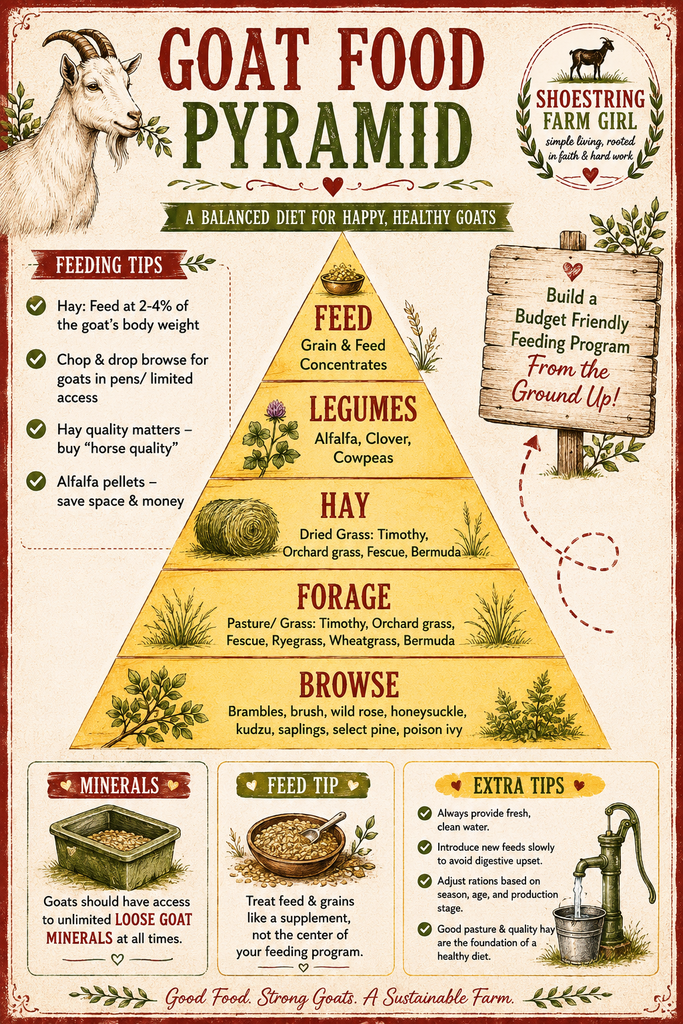
Phosphorus shows up in young forage, legumes, browse, and oilseed meals. Mature grass hay is the short one, a bermudagrass bale cut late can sit under what a growing or milking goat needs. Grain and commercial concentrates are the opposite. Corn, sweet feed, and most pellets are phosphorus-heavy and calcium-light. Relying on a bag of grain as the base of your feeding program can cause problems. This is where following the Goat Food Pyramid is helpful when developing a solid balanced feeding program. The mineral is easy to underfeed on pasture and browse only, yet easy to overfeed in a bucket of feed.
In a healthy goat, phosphorus works with calcium in bone, and it is part of the energy currency in every cell. Appetite, growth, and milk depend on it. When the diet is balanced you never see it. When it is missing, the goat gets slow, picks at dirt or wood, and loses interest in feed. Those are the deficiency signs, not dramatic, which is why they get blamed on worms or other causes. Phosphorus deficiency is rarely considered a cause, especially when every community thread is anti-feeding anything with phosphorus in it. Paints phosphorus as a “bad guy.”
Deficiency develops in a strange modern way, not the typical way we see other deficiencies develop. The warning “never feed males grain because it causes urinary calculi” is half right and widely over-applied. People hear it and strip every source of phosphorus out of a male’s diet, including the mineral that was balancing a grass-hay ration. A wether on mature hay, no grain, and a mineral he will not eat can actually run short. The fear of the stone creates the deficiency the stone warning was never about.
Urinary calculi are stones. The phosphorus-driven kind is usually struvite, and it forms when the diet is high in phosphorus relative to calcium, especially in bucks and wethers on grain. The calcium-driven kind is calcium carbonate, more common on heavy alfalfa or extra limestone. Both can block a male. Neutered males are at higher risk because of the anatomy, not because phosphorus is poison. Prevention is the ratio, about 2:1 calcium to phosphorus, plenty of water, and no free-choice sweet feed as a hobby. Grain for a thin goat, a buck in rut, or a growing kid is fine if the calcium comes with it, from legume hay or from a mineral that contains dicalcium phosphate. A meat herd on grass hay plus that mineral meets phosphorus without a grain bucket. A pet wether on sweet feed is the emergency everyone is trying to avoid.
Look for dicalcium phosphate in your mineral mix and stop guessing from the internet rule. Do not pour on corn to fix a phosphorus deficiency. If you need to supplement a male with calories add a little alfalfa in addition to the grain mix is a good rule.
7. Magnesium
Magnesium keeps nerve signals and muscle contraction in order, in a healthy goat that work is invisible. She moves, chews, and milks without the twitch that shows up when blood magnesium falls. The body does not store a useful reserve of it, so she needs a steady daily supply. Legumes are the better natural source, alfalfa and clover usually carry enough. Mature grass is borderline on magnesium, lush spring grass and cereal forages are the ones that fail.
Deficiency builds when the grass is growing fast, high in potassium and often nitrogen, and low in available magnesium. Most often in spring, or after periods of drought. Goats with access to browse will his that harder if available than fresh spring grass because it has higher nutrient value. Potassium is the blocker. Most magnesium is absorbed across the rumen wall, high potassium changes the electrical gradient that drives that absorption, so even a forage that tests with some magnesium does not deliver it. The goat can be eating and still running short. Ordinary shortfall looks like poor appetite, nervousness, or a doe who is just “off.”
Grass tetany, also called lactation or grass staggers, is that crash. It hits does in early milk on lush cool-season pasture. Milk pulls magnesium out, the rumen is not absorbing enough, and blood levels drop. She starts twitching, staggering, grinding her teeth, then goes down in spasms and it moves quickly. A heavy milker is the usual victim, and some dairy breeds are more prone to issues. Legumes in the pasture or in the rack lower the risk, so feeding alfalfa after kidding helps on many nutritional levels without adding an extra cup of individual loose minerals. Straight cereal grass in a wet spring raises it.
The safe correction for most herds is the magnesium already in a goat mineral. A separate dish earns a few weeks in a dairy group with a tetany history, not every lactating doe, seasonally timed to the flush of spring grass. The form that works is magnesium oxide. It is concentrated, inexpensive, and unpalatable, which is why it belongs mixed into the mineral rather than offered plain. Even if a does is deficient, she may not consume it based on the taste, salt is the driving carrier in this scenario. Magnesium sulfate is more for treatment under a vet, not a feeder, and is typically only recommended for does prone to tetany where nutrition and mineral mix is not correcting the issue.
Dolomitic limestone is a poor source, do not free-choice a high-mag mix year-round. Excess magnesium brings diarrhea, depressed intake, and in high amounts loss of reflexes. It can also slow down contractions in does during kidding. The diet does not need to exceed about 0.4 percent. For a down doe, this is a veterinary emergency, not a mineral-bar problem. Prevention is the loose mix, some legume for the milkers, and attention in the weeks the grass is bright and fast.
8. Iodine
Goats are supposed to get iodine from the plants they browse, which pull it from the soil. Large parts of the interior United States and the Great Lakes region simply do not have much in the ground. High rainfall leaches what is there, plants in the brassica family and white clover add another problem. They contain goitrogens that interfere with iodine use and raise the amount a doe needs. A herd on eastern or midwestern forage can look well fed and still be short, especially if the mineral was switched to a non-iodized salt to save a dollar.
In a healthy goat, iodine is the raw material for thyroid hormone. That hormone runs metabolism, growth, and the development of the kid in utero. Adults can coast on stored iodine for a while, a fetus cannot. This is why deficiency shows up in the kidding pen more often than in the doe herself. A goat mineral with iodized salt is the tested, boring, effective route. Kelp also supplies iodine and is becoming a popular option, and at a typical feeding rate it supplies plenty. The difference is control; the loose mineral mix is formulated. The kelp scoop is easy to stack on an already iodized mix, plus many goats like the taste making it easy for them to eat more than they need.
Kelp landed on mineral bars for three reasons, and only one of them holds. It does deliver iodine, so if someone is feeding plain non-iodized salt, kelp can cover that gap. Goats usually like the taste, which makes it feel like a success when the feeder empties. The trace-mineral claim does not survive the math. A common livestock kelp mineral supplement runs around 780 ppm iodine, which is useful, and about 12 ppm zinc, 4 ppm copper, and 0.5 ppm selenium.
At a quarter-ounce a day those last three add almost nothing next to a balanced feeding program, and do not get them closer to the daily recommended mineral intake. Iron is higher and not helpful, remeber our iron and copper issue. People reach for it for anemia because it is dark and sounds like seaweed iron, and yes it does contain iron. Parasite anemia is blood loss, no study shows kelp or iodine raising the packed cell volume of a wormy goat with a low FAMACHA score who is anemic. The eyelid stays pale until the worms are dead and she has protein and time.
There is one form anemia kelp or iodine can help, it isn’t caused by parasites which. Long-standing hypothyroidism from iodine deficiency or an actual thyroid problem, can produce a mild anemia along with goiter, poor growth, and low thyroid hormone. In a small study of clinically goitrous goats, oral iodine shrank the thyroid and the blood values improved as the animals recovered. That diagnosis requires bloodwork showing low thyroid hormone, not a pale eyelid in July and a barber-pole worm problem. Treating parasite anemia with kelp wastes time the goat does not have.
Deficiency looks like a swollen thyroid on a kid, weak or hairless newborns, stillbirths, and does that are slow to cycle. The best treatment is iodized salt inside the goat mineral, every day. Kelp is an acceptable iodine source only when the salt is not iodized, think your pink Himalayan salts, and you are not already covering it another way. It is not a second mineral program, and it is not an anemia treatment.
9. Cobalt
Cobalt reaches a goat through the plants she eats, and the plants only have what the soil gave them. Sandy coastal ground, heavily limed pastures, and some inland soils run short. Even where a little cobalt is present, it is easy for a browser on limited forage or a herd on hay from those fields to miss it. This is not a mineral she stores in useful amounts. The daily supply has to keep coming.
Inside a healthy goat, cobalt itself does almost nothing. So, how did cobalt end on this list? You will often hear me mention the microbiome in the rumen, this is where cobalt shines. Rumen microbes use it to build vitamin B12, and B-complex injections is one of the most commonly recommended treatments for a variety of ailments in goats. That B12 is what the goat uses for energy metabolism and for making red blood cells. No cobalt, no microbial B12, and the whole chain slows down. Appetite is usually the first thing to fade because the energy pathway is impaired. Red-cell production follows.
On a biological level, B12 is required for the maturation of red blood cells in the bone marrow. Cobalt supports that process only by keeping the B12 supply available. It does not speed the timeline, even with perfect protein and every mineral in place, new red cells still take weeks to appear in useful numbers. For a goat recovering from barber-pole anemia, cobalt in the daily mineral is one of the building blocks that lets her rebuild once the worms are gone. It is not a treatment that replaces the blood she just lost, and it will not raise a packed cell volume this week, and cobalt is not a replacement for B-complex in a sick goat. Sufficient supply in the goat’s daily diet will help provide the building blocks as she recovers from anemia over the next 4-6 week.
Deficiency looks like a thin goat who will not eat, loses weight, grows poorly, and turns up anemic with a negative fecal. It is easy to keep treating for parasites because the signs match and cobalt is rarely the first guess. Kids are hit harder because they are growing. The fix for a true deficiency is cobalt in the loose goat mineral so the microbes can make B12 again. A cobalt bolus exists for known deficient farms. A side dish next to a mineral that already contains cobalt is extra, not better. The pale eyelid in summer is still a parasite problem until the fecal says otherwise. Cobalt belongs in the everyday mix so recovery can happen. It does not start the recovery by itself.
10. Manganese
Manganese comes from the forage, and the amount swings with the soil and the plant stage. Young pasture can be adequate if you have enough acreage to support your herd, mature grass and dried hay have lower levels. High calcium or high phosphorus in makes what in your feeding program make manganese harder to absorb, so an alfalfa-heavy or grain-heavy diet can worsen a borderline forage. Browse helps more than a single-species field, but most domestic goats are not eating a wide enough mix year-round to stay covered.
In a healthy goat, manganese is part of bone formation, cartilage, and reproductive function. It supports the enzymes that build sound kids and keep a doe cycling. You never see it working if they have an adequate supply, that is why it makes the list even though it is quiet. A commercial loose goat mineral already carries it at a useful level, and the diet target sits nearer 20 to 40 ppm. One extension table still lists a manganese maximum of 3 ppm, that number does not match the current research and literature.
Deficiency does not announce itself with a fishtail or a down doe. Kids grow slowly or show weak, knuckling joint, does abort, cycle poorly, or settle late. It is easy to blame genetics, a hard kidding year, or worms. By the time it is obvious, the breeding season is already thin. In many cases, like a lot of trace minerals, these issues are blamed on other reasons that are not a mineral deficiency.
Again, with most of the minerals we have discussed, a quality loose goat specific mineral mix will have you covered. You do not need a manganese dish or a bolus. If the loose goat mineral is available, dry, and being eaten, this one is already handled. A separate manganese source is how a buffet gets longer without fixing anything the bag was not already doing.
The budget feeder
Buy one loose mineral labeled for goats, with copper and selenium on the tag and iodized salt. Keep it dry, a wet mineral cakes and they stop eating it, which looks like a deficiency and is actually a feeder problem. Watch intake, how often are you filling it? There is a natural seasonal flow on every farm, learn when your goats utilize more minerals. If they ignore it, the salt level or the location is wrong before the recipe is wrong. The recommended daily amounts and guaranteed analysis on the bag do not change, and a goat that really feels they need a mineral will utilize it.
So, the 3 budget friendly steps to ensuring your goats get what they need?
- Build a solid feeding program that meets your goat’s nutritional needs. Utilize the Goat Food Pyramid to help build your program.
- Provide a high quality bag of mixed loose minerals specifically for goats.
- Only put out individual minerals & bolus as needed (seasonally in some cases) when there is an actual deficiency.
Do not set out twenty individual minerals, it is a lot of work for minimal benefit and the cost simply isn’t worth it. Goats eat the salty dish, skip phosphorus, and overdo whatever tastes sweet. The theory behind the mineral bar is that they will self-regulate based on what they are deficient in, and consume what they need. In theory that makes sense, and may even work for a few goat owners. Or at least they think it works for them. Anyone who has ever owned a goat knows, they do not self regulate well. Give them an unsecured bin of feed and they will literally eat till they die from bloat. So why would minerals be any different? Goats are going to go for the ones that taste salty, sweet, or they just like the flavor the most. That is how toxicity and false confidence share a shelf. If they don’t like the taste of one of the minerals, they are likely not going to touch it making the owner think they are not deficient in that mineral. When they finally eat the one they don’t like the taste of they are likely already significantly deficient. Plus, most minerals feral goats find in nature are not found as individual minerals. They would naturally obtain these minerals through a variety of browse, or licking dirt near rocky areas that have high mineral content and salt.
Thank you for joining us for another week of blogging. If you are looking for a quick reference guide on nutrition, check out my Goat Feed & Nutrition Bundle.
Carrie Lynn – The Shoestring Farm Girl
References
Filley, S. (2019). Mineral requirements of sheep and goats (reviewed 2024). Oregon State University Extension Service. https://extension.oregonstate.edu/catalog/mineral-requirements-sheep-goats
Hart, S. (2019). Goat pastures mineral supplementation. Langston University / Goat Extension. https://goats.extension.org/goat-pastures-mineral-supplementation/
Merck Veterinary Manual. (2025). Nutritional requirements of goats. In Merck veterinary manual. https://www.merckvetmanual.com/management-and-nutrition/nutrition-goats/nutritional-requirements-of-goats
Mississippi State University Extension. (n.d.). Mineral requirements and impact on dairy and meat goat production. http://extension.msstate.edu/publications/mineral-requirements-and-impact-dairy-and-meat-goat-production
National Research Council. (1981). Nutrient requirements of goats: Angora, dairy, and meat goats in temperate and tropical countries. National Academies Press.
National Research Council. (2007). Nutrient requirements of small ruminants: Sheep, goats, cervids, and New World camelids. National Academies Press.
Pugh, D. G. (2020). Sheep, goat, and cervid medicine (3rd ed.). Elsevier.
-
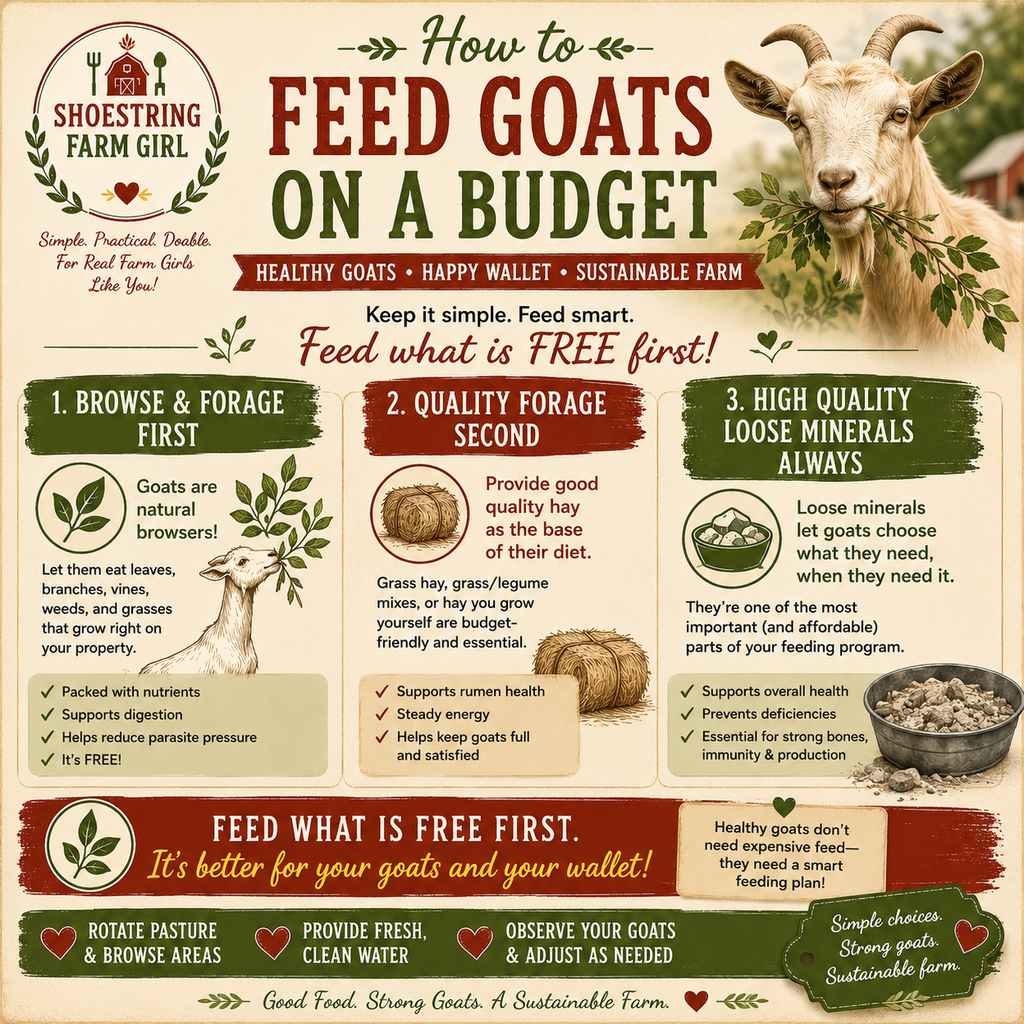
Goat Hay for Winter on a Budget: Best Types, Quality Secrets, Storage & Waste Tips That Actually Save Money
Cold weather is coming, and now is the time to buy hay for the winter.…
-
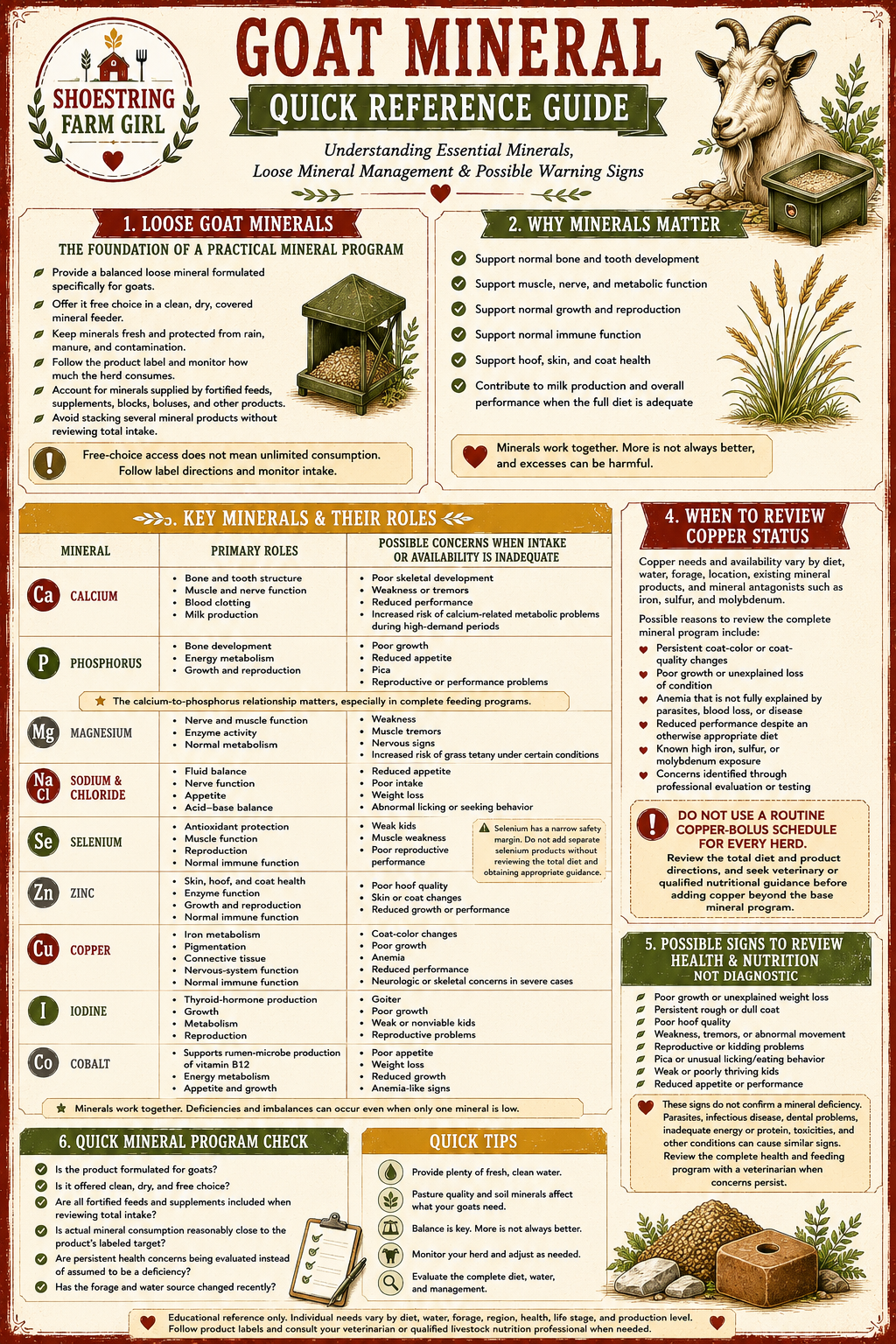
10 Minerals Your Goats Might Be Short On
10 Minerals Your Goats Are Short On and How to Supplement Without Breaking the Budget!…
-
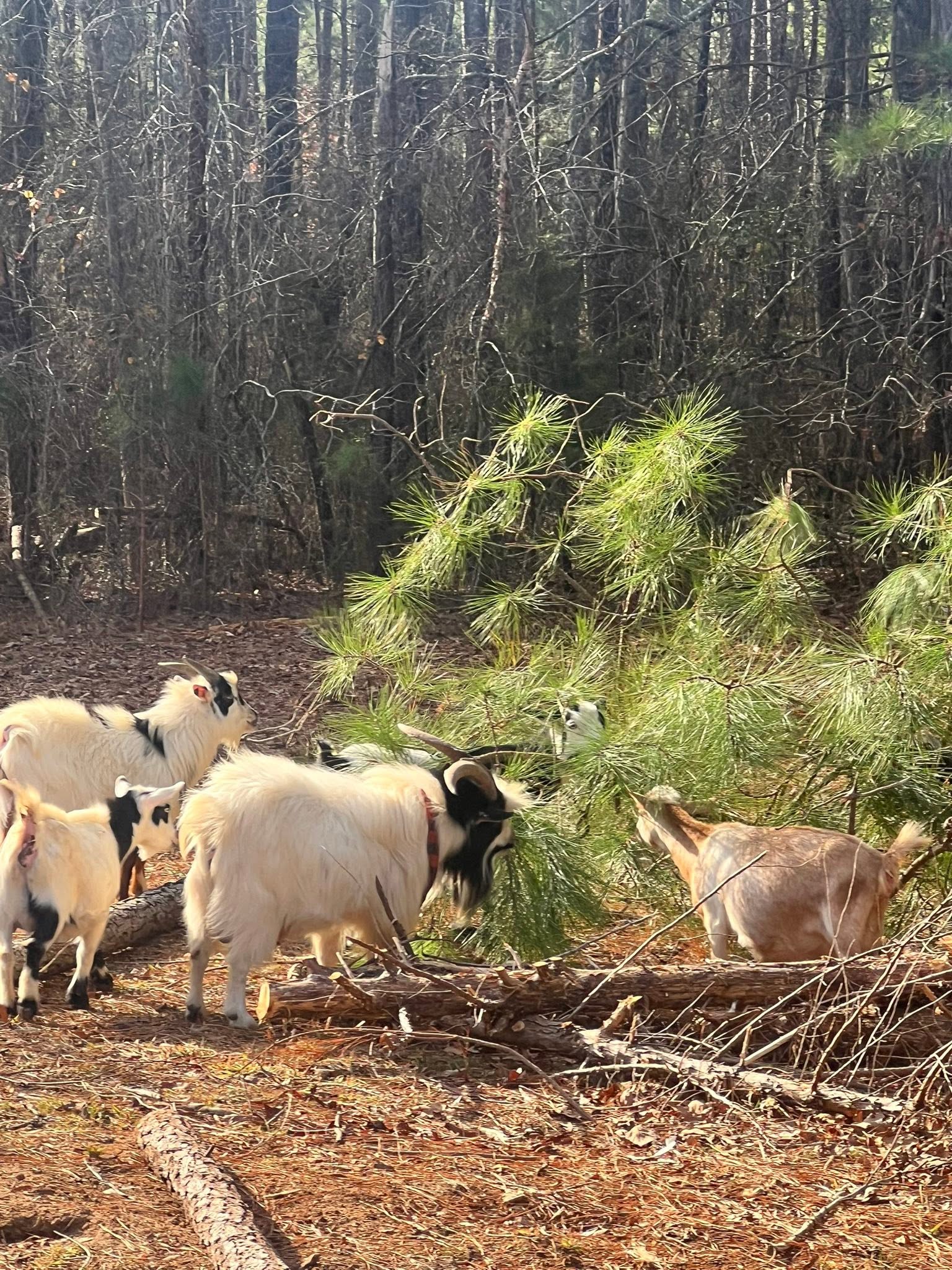
Natural Goat Dewormers: 5 That Hold Up on a Fecal, and 5 That Don’t!
Most “natural” goat dewormers die in the rumen. Here is what fecal trails and science…
