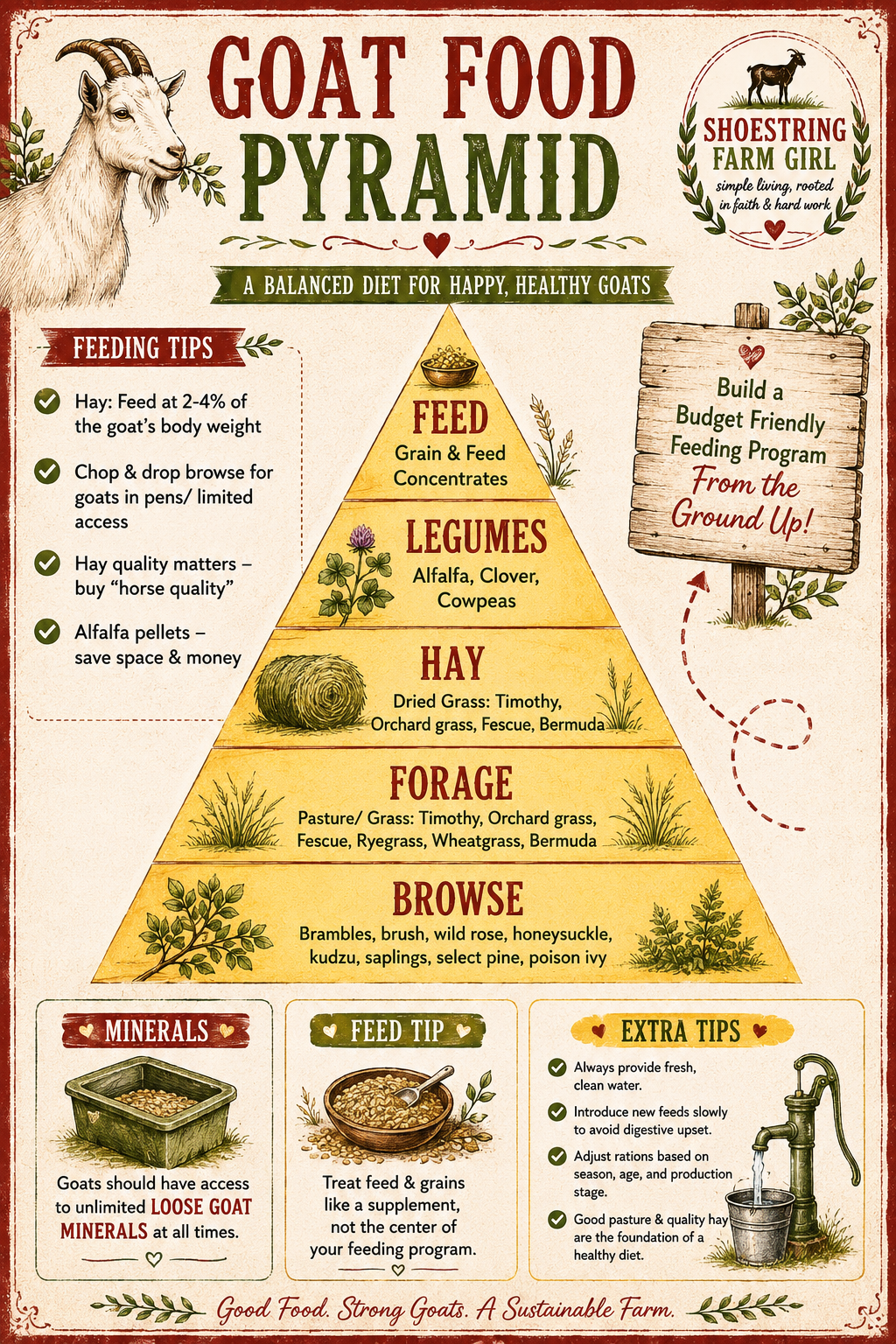
The Goat Food Pyramid
How to feed a healthy Herd Without Breaking the Bank!
Most new goat keepers start in the feed aisle. They buy a pretty bag with a goat on the front, whatever the previous owner fed, or based on a random recommendation from a stranger in your favorite goat group on social media. You scoop twice a day and wonder why your goats aren’t thriving when your feed bill rivals a car payment.
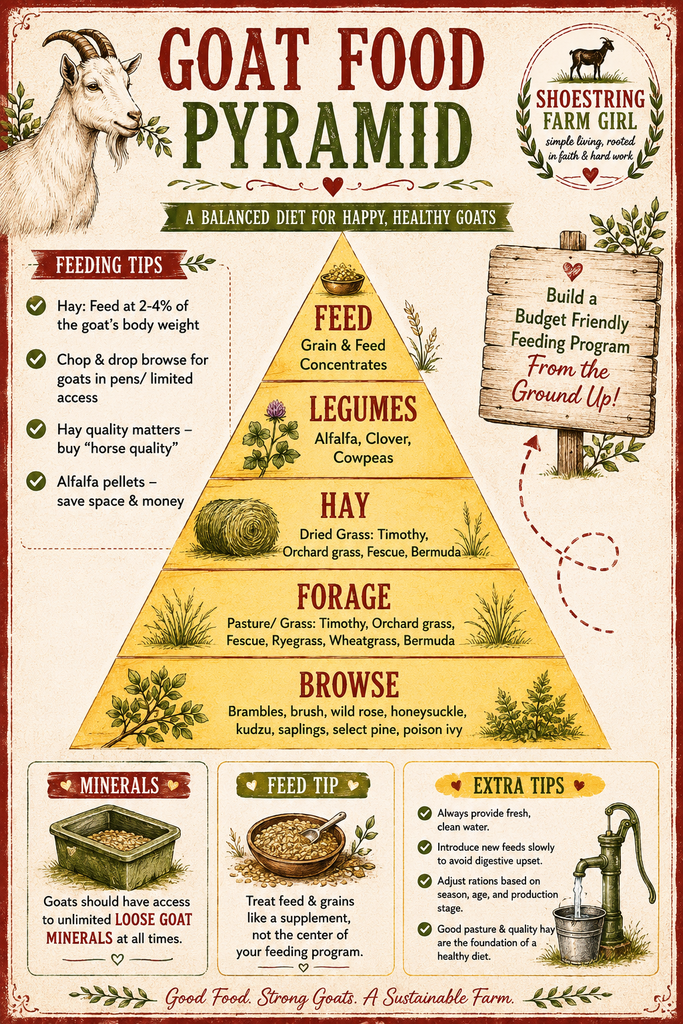
Goats are not little cows, and they will not replace your lawn mower. They are intermediate browsers – built to pick leaves, buds, bark, and brush before they ever settle into a tidy grass pasture. They would prefer to eat your landscaping over your lush lawn. They really do thrive on plants that other livestock ignore. When we put grain at the center of the plate, suddenly we have a high-calorie feed that stresses your budget and the goat’s rumen. The Goat Food Pyramid puts the diet back in the right order. Browse and forage carry the load. Quality hay holds the winter or limits land. Legumes step in when protein and calcium need a lift. Grain sits at the very tip – a tool, not a meal plan. Lose minerals and clean water sit beside the pyramid, becasue they are not optional extras.
Let’s learn about the Goat Food Pyramid and how it can fix your goat’s rumen and your budget.
Why Goat Nutrition Starts with How a Goat Eats
Watch a goat in a mixed paddock: she strips the brambles, samples the honeysuckle on the fence, works a rose cane, even dances like a ballerina to pick leaves off trees, then only later drops her head to the grass. Grass is typically the last thing they eat, unless they are in a pasture-only situation. This feeding behavior is closer to that of a deer than to that of a sheep or cow. Roughly 60% of a free-choice diet can and should be browse.
This feeding habit is designed, not pickiness. Goats have a 4-chambered stomach, with the rumen being a large fermentation chamber. They do best when they can select leaves, buds, and young stems. It feeds the beneficial bacteria in the rumen, which helps with digestion and plays a major role in the goat’s overall health.
Two numbers belong above the feed-room door. Dry matter intake is typically about 3-4% of the goat’s body weight per day – a 130-pound doe is looking at roughly 4-5 pounds of dry matter, consisting of browse, forage, and hay. Knowing how much your goat should be eating can help you plan your hay purchases through the year.
Maintenance goats do well on a diet of around 7-9% crude protein and about 50% TDN (Total Digestible Nutrients). Late pregnancy, heavy milkers, and growing kids push those numbers closer to 12-16% protein and 60-70% TDN. If the bottom of the pyramid is strong, those targets are manageable and keep that feed bill under control.
The Base: Browse is the Goat’s Real Grocery Store
So, what is “Browse and Forage”? Aren’t they the same thing? No. The terms are used interchangeably, but they actually refer to different food sources. Browse is woody and semi-woody plant material: brambles, brush/ bushes, wild rose, honeysuckle, kudzu, saplings, select pine, and yes – poison ivy. Goats are not bothered by the urushiol, the toxin in the sap of poison ivy that makes us itch, the way we are. They will strip poison ivy and a long list of thorny invaders on your property. Just know that the oil from poison ivy can stick to hair. Honeysuckle leaves and buds have been measured around 16% protein and 70% plus TDN – numbers that rival decent alfalfa. And it is free, and something considered a nuisance. Variety matters more than any single plant, because a mixed fence line covers nutrients a grass monoculture never will. You will also notice your goats selectively browsing that fence line for the highest nutrient content based on time of year, they prefer produce that is in season too.
- Let fencerows work. A messy edge is a salad bar if you keep truly toxic trees off the menu.
- Rotate. Goats high-graze to eye level. Move them before they peel bark off trees you want to keep.
- Walk the paddock after storms. Fallen willow or elm are a winter treat. Wilted wild cherry is a funeral waiting to happen. Identify the plants on your property.
- Hungry goats on bare dirt eat the wrong thing. Full goats with options almost always choose the right thing.
Forage: Pasture That Works with a Browser
When you think of forage, think of grassy pastures. Pasture is the next layer – timothy, orchard grass, fescue, ryegrass, Bermuda, whatever your climate will grow. Goats will graze, especially when grass is young and leafy.
Vegetative pasture can run 12-24% crude protein and 60-76% TDN. That is a wide range and depends largely on pasture management and climate. Rotation is how you keep this layer cheap and keep parasite load from writing your stocking rate for you.
When grass is short, brown, or frozen, stop pretending the paddock is still feeding them. The protein level drops. That is when hay has to step up – not grain.
Hay: The Backbone
Hay is dried grass stored for winter feeding. If you keep goats in pens, or have limited browsing and pasture, hay is the next staple on your list. On most homesteads, it is the biggest feed expense, which means sloppy buying quietly wrecks your budget. However, in terms of price per pound, it is cheaper and better for the health of their rumen and digestive system. Quality swings hard with cutting date. Not just that, but I tell new goat owners to fine “horse quality hay.” Many farmers will sell hay cheaper as goat hay because it is no longer suitable for other livestock for a variety of reasons. Goats have a reputation for “eating anything” because they typically browse and eat plants that other livestock don’t. That doesn’t mean they should eat overly dusty or moldy hay, or hay that has been sitting in a barn for 2 years and has virtually no nutritional value left. You cannot see protein with your eyes, but you can see dust, some mold, and stem.
- Hay should smell sweet, not musty. Moldy hay is not a bargain.
- Gree-gold beats gray. Black anywhere is a no.
- More leaf in the lay vs stem, more nutrition. Stemmy hay fills the rumen and starves the goat.
- Store off the ground and under cover. A pallet and a tarp have saved more herds than a fancy barn.
Offer hay free choice in a feeder off the ground that keeps it out of the bedding. Most adult goats can eat 3-5 pounds of hay each when pasture is gone or pen kept. A standard dairy goat may require up to 4-7 pounds of hay per day, depending on milk production. Watch body condition, not just the scale.
Legumes: The Protein and Calcium Step-Up
Alfalfa, clover, and cow peas sit above grass hay because they work harder. Legume hay typically tests at 13-20% crude protein, with more calcium than grass hay. That is why alfalfa shows up in late pregnancy and on the milk stand. Alfalfa is the most common type of legume fed to goats and comes in a variety of forms; alfalfa hay bales just like you would buy grass hay, chopped or compressed bags of alfalfa, or alfalfa pellets. All are good options. My go to it typically the chopped or pellets if you are budget conscious and have limited hay storage.
Always add legumes before adding feed from a bag. Why? Goats, especially males, depend on a very specific calcium-to-phosphorus (Ca:P) ratio in their diet, typically 2:1 or 3:1. Legumes are high in calcium, whereas feed products are high in phosphorus. Adding the higher calcium option first will offset the increase in phosphorus in feeds. Sometimes even reducing the need to give feed altogether.
The Tip: Grain is a Supplement, Not a Lifestyle
Here is the sentence that saves more goats than any product I can name: treat feed and grains like a supplement, not the center of your feeding program. Just because you are not scooping feed from a bag does not mean your goat isn’t getting what they need in their diet, especially if you have a solid foundation in your feeding program.
Concentrates – corn, oats, barley, pelleted goat feed, wheat, BOSS (black oil sunflower seeds), soy hulls – are dense energy. They have a job: Late pregnancy, early lactation, thin goats coming off parasites or a hard winter, and fast-growing kids. Goats are recovering from illness. Dry does in good flesh, mature bucks on maintenance, and pet wethers on decent hay often need little to none.
When grain becomes the easy button, three problems show up. Rumen acidosis from dumping starch on fiber-digestion microbes. Enterotoxemia risks when a sudden rich meal meets Clostridium perfringens – one reason we change rations slowly. And urinary calculi in bucks and wethers, because cereal grains run high in phosphorus. Excessive phosphorus in alkaline urine promotes stone formation in a narrow urethra. That is an emergency, not a wait-and-see.
That is NOT to say NEVER feed a goat grain. Never feed grain to male goats is a common thread I have noticed in many goat groups on social media. Feed the goat in front of you. If a goat is underconditioned, recovering from illness, bucks in rut, or late gestation does; they may need that calorie dense food to maintain health.
Change amounts over 7-10 days. Whole cottonseed, soy hulls, and beet pulp can add energy with more fiber than grain and can be an option to bump calories in the winter without “feed.” They still should count as the tup of the pyramid.
Feeding on a Budget
- Grow or trage forage before you buy bags. A brushy back corner out-earns a cart of textured feed.
- Buy hay by the ton from a known field when you have storage, not by the bale at the local farm store.
- Test hay if you are feeding milkers or buying large quantities (a years’ worth at one time)
- Use safe tree trimmings. Skip the ornamental cuttings you cannot name.
- Change one thing at a time. Give the rumen a week to adjust before making more changes.
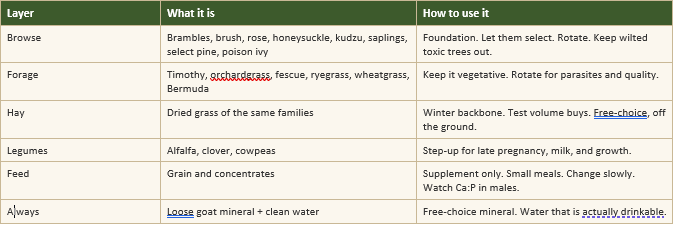
The Pyramid at a Glance
Get the Free Goat Food Pyramid Printable
If you want this hanging in the barn instead of living in a browser tab, I made a one-page Goat Food Pyramid printable – the same layers we just walked through, plus the mineral, feed, and water reminders. It is free when you join the Shoestring Farm Girl monthly newsletter. Each month I send practical homestead and livestock notes, budget solutions that have actually worked here, seasonal reminders, and information to help you build your homestead on a budget. Join at Newsletter Landing Page – Shoestring Farm Girl, grab the PDF printable, and pin it where you mix feed.
Remember: Feed the animal in front of you!
Carrie Lynn – The Shoestring Farm Girl
Blog
This section provides an overview of the blog, showcasing a variety of articles, insights, and resources to inform and inspire readers.
-
Goat Hay for Winter on a Budget: Best Types, Quality Secrets, Storage & Waste Tips That Actually Save Money
Cold weather is coming, and now is the time to buy hay for the winter.…
-
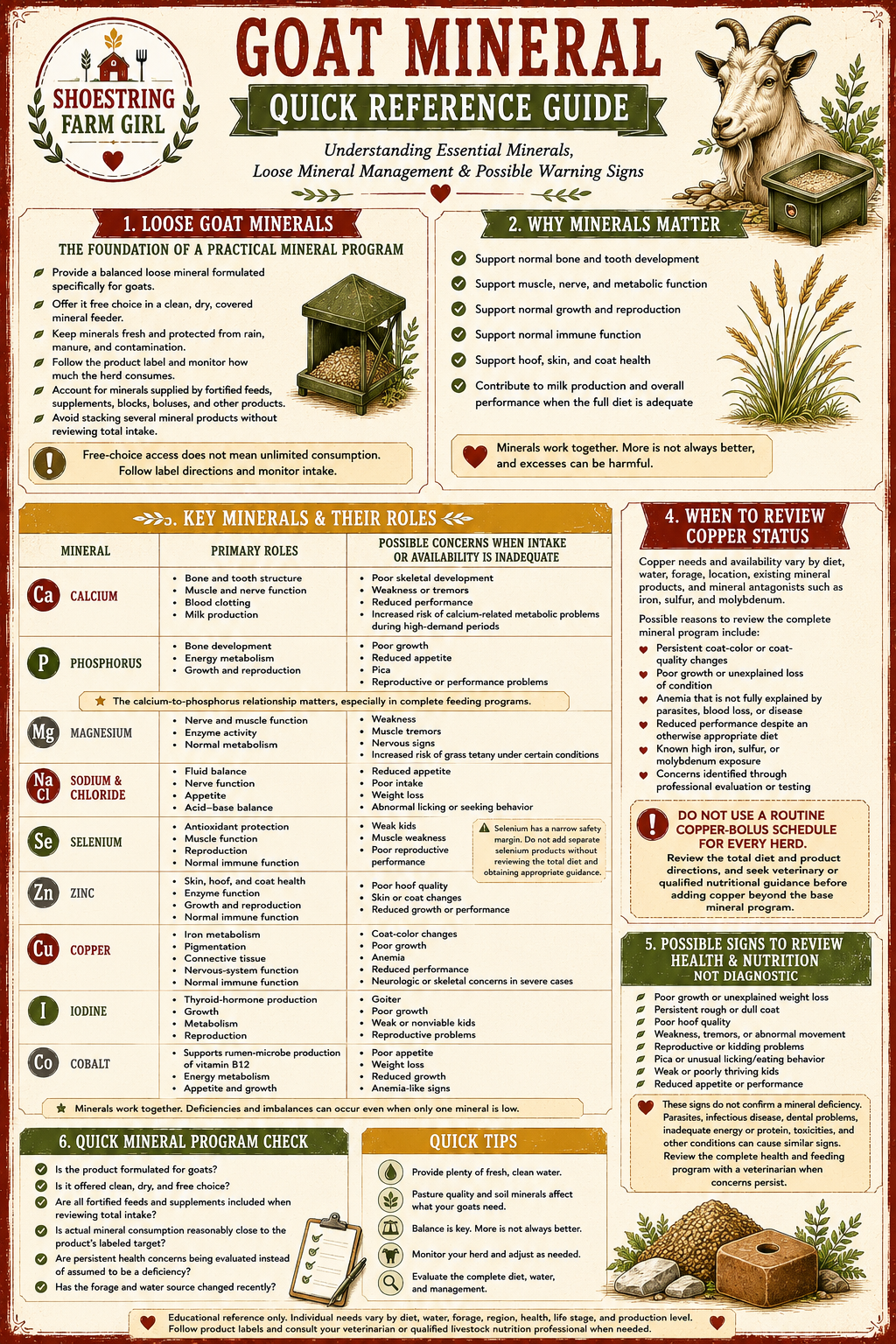
10 Minerals Your Goats Might Be Short On
10 Minerals Your Goats Are Short On and How to Supplement Without Breaking the Budget!…
-
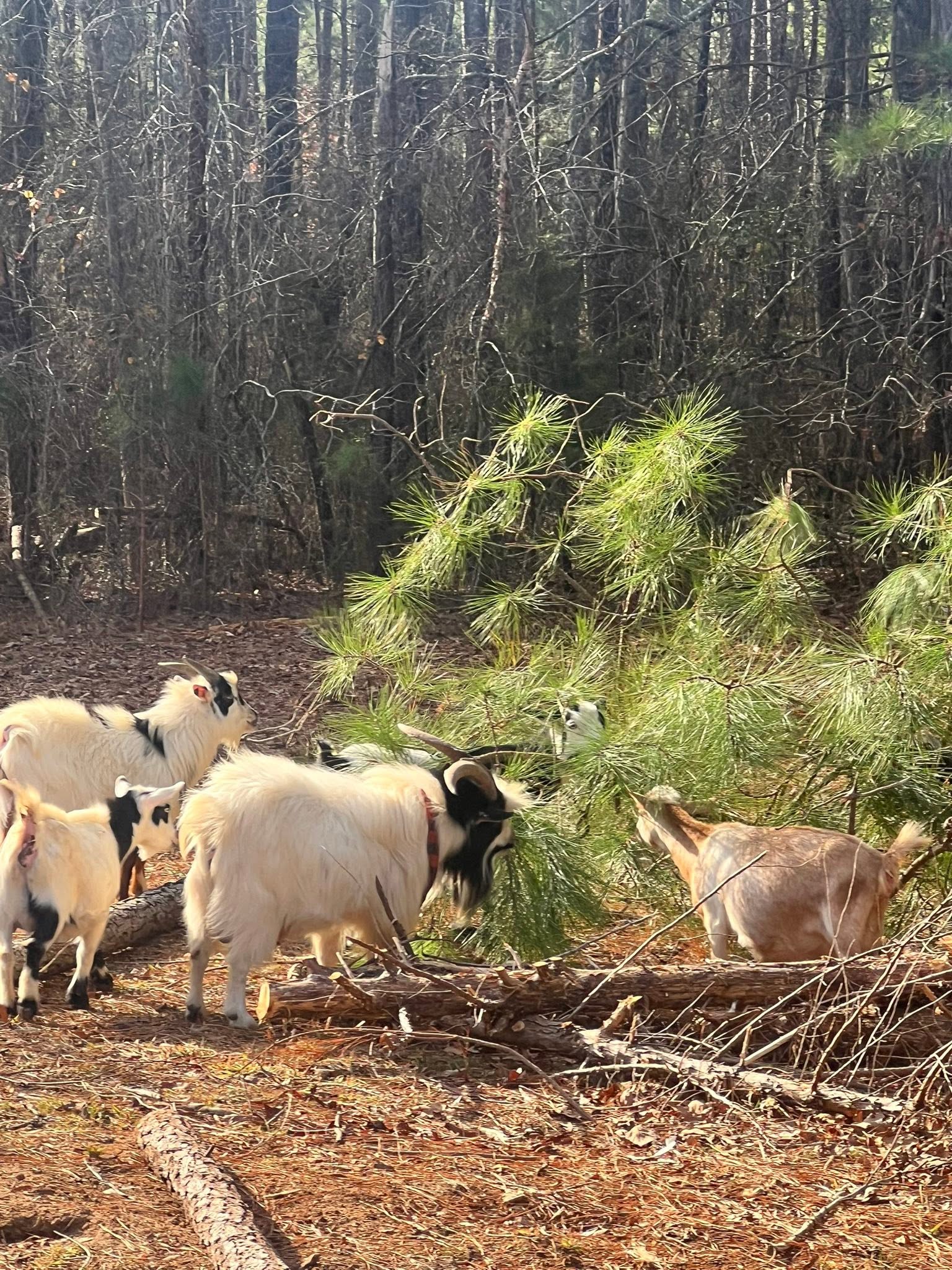
Natural Goat Dewormers: 5 That Hold Up on a Fecal, and 5 That Don’t!
Most “natural” goat dewormers die in the rumen. Here is what fecal trails and science…
